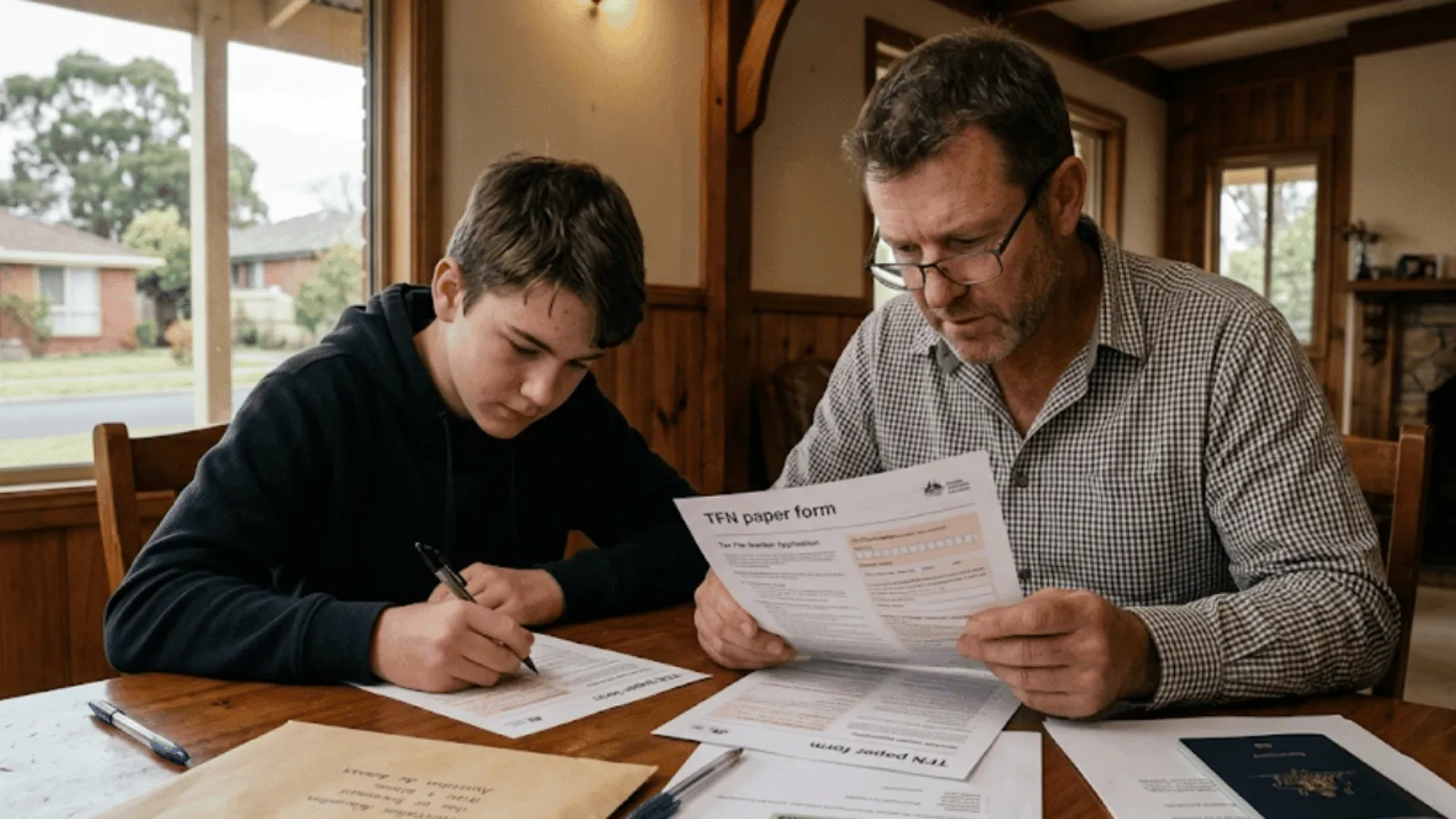
Starting your first job at 14, 15, 16 or 17? Helping your child get ready for casual work? A Tax File Number (TFN) can make the payroll and tax side of that first job much easier, and there is no minimum age to have one in Australia.
You don't necessarily need a TFN in your hand before your first shift. However, not quoting one can lead to higher tax being withheld from your wages once the relevant declaration rules apply. Getting the application underway early gives you time to gather the right identity documents and avoid an unnecessary payroll problem.
The part that often confuses families is that a 12-year-old, a 14-year-old and a 17-year-old do not necessarily follow the same signing arrangements. This guide explains the differences, what a parent can do, how the process works and what under-18s should know about income tax. For the complete list of identity options, also see the documents you need for a TFN.
Do you need a TFN if you're under 18?
There is no rule that every child must get a TFN at a particular birthday. The ATO can issue a TFN at any age, and the number is commonly useful when a young person starts work, has tax matters to manage or needs to deal with certain financial or government arrangements.
For a teenager beginning casual employment, a TFN helps their employer apply the appropriate payroll withholding arrangements. It can also be useful later for tax returns and superannuation records.
Not having a TFN is not, by itself, a prohibition on starting work. But it is worth understanding the declaration and withholding rules, rather than finding out about them from an unexpectedly reduced payslip.
TFN age rules: under 13, 13-15 and 16-17
The ATO has specific rules for who signs an approved application for a child or teenager.
These are especially important when completing a paper TFN application.
| Age of applicant | Who generally signs the approved application? | Practical implication |
|---|---|---|
| 12 or younger | Parent or guardian | Adult identity and proof of relationship are relevant |
| 13 - 15 | The young person or a parent/guardian | A parent can assist and, where permitted, sign instead |
| 16 - 17 | The young person | Parent may help prepare documents, but the young person generally signs |
| 18 or older | The adult applicant | Standard adult signatory arrangements |
When a parent or guardian signs for a minor, the ATO may require proof of identity for both people and documents establishing their relationship.
These rules are not the same as eligibility for the ATO's myID application. An Australian citizen aged 15 or older with an Australian passport may qualify to apply through the Digital ID route. An otherwise eligible 14-year-old cannot use that route solely because their parents have a myID account.
TFN for a child under 13
You may be organising a TFN for a young child because of a particular tax, investment or administrative need, rather than a first job.
A parent or guardian must generally sign the appropriate approved application on the child's behalf. Prepare the child's identity evidence, the adult signatory's identity evidence and proof of the relationship, following the ATO's current checklist.
A child's TFN belongs to the child, not to the parent. It should not be used as the adult's tax identifier or shared with people who have no legitimate reason to collect it.
If the issue relates to savings, investments or trust distributions, do not assume that opening an account in the child's name produces the same tax outcome as wages from a part-time job. Special tax rules can apply to some income of minors.
TFN for 13-, 14- and 15-year-olds
This is a common age range for a first after-school or holiday job. A 13- to 15-year-old can generally sign the approved TFN application themselves, or a parent/guardian can sign, depending on the method and circumstances.
For 15-year-olds with an Australian passport: if they are Australian citizens and meet the Digital ID requirements, the ATO may provide a direct online myID pathway. It can be considerably faster than a conventional paper application.
For 13- or 14-year-olds: plan around the other ATO application routes and their proof-of-identity rules. Do not follow online instructions aimed only at eligible applicants aged at least 15.
Parents can help collect documents, check personal details, understand the chosen ATO form and make sure any mail is received securely. They should also talk to the teenager about why a TFN must be kept private.
TFN for 16- and 17-year-olds
Older teenagers often apply as they take on their first regular job. They generally sign their own approved application, even if a parent helps them prepare it.
An Australian citizen with an Australian passport may qualify for the myID application. Otherwise, the correct route may be an Australian-resident pathway involving Australia Post or a paper form. Eligible temporary visa holders follow their own ATO immigration-related route.
The main preparation points are straightforward: confirm the correct applicant category, gather the identity evidence, use an accurate postal address and retain any reference details.
How does a teenager apply for a TFN?
The process to apply for your TFN varies, but this sequence works as a planning guide for most families.
Step 1: Check whether a TFN already exists
A TFN normally stays with the person for life. If the child was issued one for an earlier purpose, do not automatically make a second application. Check existing records or contact the ATO through its authorised channels.
Step 2: Choose the right applicant pathway
An Australian citizen with an Australian passport who is at least 15 might be able to use myID. Other residents may apply using the Australia Post or paper processes. Eligible temporary visa holders in Australia use a different application route. Age, documents you need and immigration status all matter.
Step 3: Prepare identity and signatory documents
For younger applicants, have the appropriate birth certificate, passport or other ATO-accepted identity evidence available. Where a parent or guardian signs, check what adult identification and relationship evidence is required. The exact combination depends on the application method.
Step 4: Complete the application carefully
Use the child's correct full legal name and date of birth. Review the address and identity details. If an Australia Post appointment is required, follow the ATO's instructions and deadline.
If a paper application is required, follow its certification and mailing requirements.
Step 5: Save the reference and wait for the TFN
The ATO generally states that TFNs are received within 28 days of a completed application, although the eligible Digital ID method can be much quicker. If the number has not arrived after 28 days, contact the ATO rather than making a duplicate submission.
For the complete timeline, see how long a TFN takes to arrive.
\
Do you need a TFN to work under 18?
If you're under 18 and looking for work in Australia, you'll need a Tax File Number (TFN) to avoid paying more tax than necessary. Your employer uses it to work out how much tax to take out of your wages. You can still start work without one, but you should apply as soon as possible. This applies whether you're working a few shifts after school, picking up weekend hours or getting a job during the holidays.
How to apply for a TFN under 18 (under 16)
Children under 16 can apply for a TFN, although the steps may differ depending on their age and identification documents. A parent or guardian can help with the application, particularly if extra documents are needed to confirm the child's identity. You don't have to wait until you've found a job to apply, so it's worth sorting out your TFN beforehand.
TFN for your first teenage job
Got your first job lined up? One thing you'll need to sort out is your TFN. When you start working, your employer will ask you to complete a TFN declaration so they know how much tax to withhold from your pay. If you haven't received your number yet, you can let your employer know you've applied. That way, you can get started while you're waiting for the ATO to issue it.
What documents does a teenager need for a TFN?
The precise proof-of-identity requirements depend on the route, but documents worth checking may include a birth certificate, an Australian or foreign passport where relevant, or other evidence accepted by the ATO.
Where a parent or guardian signs, adult proof of identity and evidence of the relationship may be necessary. The ATO's official document list is the final authority; do not assume that a school ID card or a parent's Medicare card can always replace a formal document.
For Australia Post: follow the list of original identity documents required for the interview.
For a paper form: provide the certified copies required by that form, not your original identity documents.
For a Digital ID application: ensure the young person meets the age and passport criteria and can complete the official verification.
Read our detailed TFN document checklist before gathering unnecessary documents or photographs.
Can you start your first job before getting a TFN?
Generally, yes. A teenager can start work while waiting for their TFN, provided they meet the applicable employment and work-rights requirements. The employer will need the information required for payroll, including a TFN declaration.
If the worker has genuinely applied for a TFN and says so on the TFN declaration, the ATO's withholding instructions generally allow 28 days to quote the number. If the TFN is not supplied after that period, the employer may need to withhold at the relevant no-TFN rate unless an exemption or other rule applies.
For resident employees, the ATO identifies a 47% rate in the relevant no-TFN circumstances. That does not mean every teenager without a TFN automatically loses 47% of their very first payslip, and it does not mean their final income tax rate is 47%.
The separate TFN declaration form guide explains what happens when you start a job. Make sure the information you provide your employer is accurate.
Do under-18s pay income tax in Australia?
Sometimes. Age alone does not make all income tax-free. The tax treatment depends on the kind of income, residency status, overall taxable income and other circumstances.
Wages from a genuine part-time job
Employment income earned by a minor is generally treated as excepted income for the special minor-tax rules. This means that, in common circumstances, ordinary individual tax rates can apply rather than the higher rates imposed on certain other income of minors.
An Australian resident with only qualifying excepted income may benefit from the ordinary $18,200 tax-free threshold, subject to the applicable rules. That helps explain why a school student earning a relatively modest amount from weekend shifts might ultimately owe little or no income tax.
However, payroll withholding is calculated during the year; the final amount owed is determined under tax rules and, where required, through a tax return. Don't promise that every student earning less than $18,200 will automatically see no deductions from their pay.
Bank interest, investments and other income
Income from savings, investments or certain trust arrangements can be treated differently from wages. The ATO's special rates for minors are designed in part to prevent income being diverted from adults to children to reduce tax.
This means a child with investment income should not simply assume that their income is always tax-free up to $18,200. The particular source of income matters, and some types may qualify for exceptions.
If your child's circumstances involve investments or trust distributions, check the ATO's income rules for people under 18 or obtain appropriately qualified tax advice.
Should a school student claim the tax-free threshold?
A person who is entitled to the tax-free threshold can usually claim it from their main employer through the relevant TFN declaration. Having more than one job, being a foreign resident for tax purposes or receiving other income can change what is appropriate.
The TFN itself does not automatically grant the tax-free threshold. It allows the employer to identify the taxpayer; the employee must also provide accurate declaration information and meet the relevant eligibility conditions.
For further detail, see how the tax-free threshold works in Australia.
A parent or guardian can support the preparation
A parent or guardian can sit with the teenager while they review the instructions, help them keep track of questions and encourage them to understand what they are being asked to do. The teenager should remain involved in the conversation and preparation, rather than having information handled without their understanding.
A practical discussion can stay simple:
- What does the teenager already know about their TFN situation?
- Which current official instructions apply to their age and circumstances?
- What is still unclear and needs to be checked with the ATO?
- What has the employer asked the teenager to complete, and where should questions about it go?
These are preparation prompts, not a substitute for official instructions. If the teenager needs a detailed list of documents to consider before applying, see the TFN document preparation guide, which covers that separate task.
What should parents know about privacy and safety?
A TFN is sensitive personal information. Young workers may be asked for one by an employer, superannuation fund or another authorised organisation, but they should not share it merely because someone sends a text message or asks on social media.
A parent helping a younger child should store the number securely and only disclose it where there is a genuine authorised purpose. Teenagers should understand that the number stays with them as they change jobs or move away from home.
If a TFN letter is lost, look for the existing number through the ATO's official recovery options. If the number may have been stolen or misused, contact the ATO promptly.
Common mistakes when applying for a teenager's TFN
- Following adult-only instructions: some online application routes have minimum ages that do not apply to obtaining a TFN generally.
- Assuming all under-16s need parental signatures: 13- to 15-year-olds may sign themselves under the ATO's general rules.
- Letting a parent sign a 17-year-old's approved application: the ATO generally requires applicants aged 16 or older to sign their own form.
- Using the wrong identity evidence: an Australian-resident paper form is not the same as an eligible visa-holder online application.
- Waiting until the first payday: allow time for any required verification, especially if starting a job soon.
- Confusing income tax with withholding: a high payroll withholding rate when no TFN is quoted may not reflect the worker's final tax liability.
- Treating all children's income the same: wages and some investment income can be taxed differently.
Ready to organise a first TFN?
If you or your child would prefer help checking the correct application route and preparing the details, e-docshub offers optional paid assistance for TFN applications. The ATO issues the number and controls the processing timeframe.
Apply for your TFN
Do you know how to apply for a TFN before you start? Contact us and we'll help you choose the right path.
The ATO's own TFN application process is free. e-docshub is an independent provider of optional assistance, not an Australian government agency.